
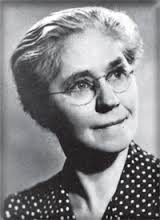
Dr Donalda Dickie was involved in devising and implementing a progressive model of education for state schools in Alberta (Canada) in the 1930s and 1940s. She led system-wide change around the concept of the enterprise, which she defined as “a series of purposeful activities arising out of the pupils’ needs and interests and revolving about one central theme.” The Enterprise emphasised social learning that underpinned the development of a sound mental health, an understanding of knowledge linked to community life, and an ability to reason through the scientific method.
Below, we present extracts from three sources on the influential role Donalda Dickie played in the movement for progressive education in Canada.
……………………………………………….
Extract from von Heyking, A. (2012). Implementing progressive education in Alberta’s rural schools. Historical Studies in Education / Revue d’histoire De l’éducation, 24(1), 93-111.
Among the educators who assisted Newland [Supervisor of Schools in Alberta] in the progressive revision of the school curriculum was Donalda Dickie, an instructor at the provincial Normal School*. Dickie completed postgraduate studies at Columbia University and Oxford before completing her PhD in History at the University of Toronto. She later drew on her experience with Alberta’s elementary school curriculum revision to author The Enterprise in Theory and Practice (1940), which became the standard text on progressive education and child-centered, subject-integrated elementary school instruction in teacher training institutions across Canada. Newland appointed Dickie … to create the new elementary school program grounded in the project approach they called, “the enterprise,” and intended to give students experience in group living through cooperative learning. The new Program of Studies described enterprises as “social experiences” and explained that “activities should be of such a nature as to cultivate the natural disposition of the pupils to express their ideas by speech, free art, dramatization, construction, writing and movement. Their activities should be as life-like as possible, so that the learnings acquired through them will be integrated and unified.” …. [Teachers] were directed to plan enterprises in consultation with their pupils and ensure that they incorporate “useful knowledge” in history, geography, science, health, literature, music and art. The program was piloted in 1935–1936 by seventy-five teachers who had received training in the child-centered, inquiry-based instructional methods required, and extended for general implementation in the fall of 1936.
Read the full article here.
* A Normal School was an institution for training teachers for state education.
……………………………………………….
Extracts from Coulter, R. B. (2005). Getting Things Done: Donalda J. Dickie and Leadership Through Practice. Canadian Journal of Education, 28(4), 669‐699.
Central to the plan (for a new elementary school curriculum) was the enterprise, the term the committee came up with to describe an interdisciplinary, child‐centred, activity method of education. Dickie herself saw the enterprise as “the co‐operative achievement of a social purpose that a teacher presents to her class with a view to having them use it as an experience in intelligent social behaviour.”
Although Dickie has been labelled variously as a pedagogical, child-centred or child freedom progressive, her own life story and her body of work reveal a woman who was also committed to traditional scholarship and the pursuit of knowledge. She did not see theory and practice as binaries and believed that children could come to learning with joy and pleasure but still master content and skills.
Read the full article here.
……………………………………………….
Extract from von Heyking, A. (1998). Selling Progressive Education to Albertans, 1935-53. Historical Studies in Education / Revue d’histoire De l’éducation, 10(1), 67-84.
The best explanation or analysis of progressive education in Alberta came from Donalda Dickie in her book The Enterprise in Theory and Practice, published in 1941 for use in Normal schools. Although traditional educationalists had accepted the acquisition of knowledge as the primary aim of schooling, Dickie insisted that “[E]ducation, when all is said, has just one purpose: to help people to learn how to live happily together in the world.” She argued that this could only be done through encouraging people to be self-confident and by assuring them of acceptance in the social group. Her sympathy for the pedagogical progressives was apparent when she insisted the school take the responsibility of developing in a child a well-balanced personality capable of happy citizenship. According to Dickie, such a citizen is characterized by “the personality sane and serene, with interests many, varied, objective, and with powers stimulated.”
Dr. Dickie, Olive Fisher, and William Hay collaborated on the preparation of the activities or “enterprises” which formed the basis of the new curriculum in the primary (I to III) and junior (IV to VI) grades. According to the new Programme of Studies, the enterprise was “a series of purposeful activities arising out of the pupils’ needs and interests and revolving about one central theme.” Out of the chosen theme, for example “Food,” students would undertake activities in the discipline areas of social studies, science, health, language and possibly several of the fine arts. Specific skill requirements in these particular disciplines disappeared from the Programme of Studies. The outcomes of the new “integrated” programme were organized instead into three categories. The first category was the “Development of the Individual Through Socialization,” and included such specific requirements as, “Development of sound mental health through establishing a happy frame of mind,” and “Development of thinking and reasoning” as opposed to unrelated memorization of facts. The second category said that students should develop “understanding through a knowledge of important ideas and facts.” Teachers were warned that facts and information learned by the student should contribute to social living; specific outcomes required that students gain “an understanding of the social life of his community,” and “an understanding of man’s increasing control over environmental forces.” The third category required students develop skills and abilities such as training in the scientific method, the ability to use tool subjects such as writing in the completion of an enterprise, and good study habits.
Donalda Dickie, Olive Fisher and William Hay spent a year meeting with educationalists and teachers and examining the school programmes of various American states. In autumn 1935, a group of seventy-five teachers, all carefully selected, piloted the new integrated programme. It was declared a success and extended to all elementary schools in the province in 1936. It remained a recommended programme until 1940 when its use was mandated by the Department. At that time, a more detailed description of the content of enterprises was provided in the Programme of Studies in the form of a grid.
Along the top of the grid were listed the nine themes of social living upon which enterprises should be based: food, clothing, shelter, work, transportation and communication, recreation, expression, education, and government, health, and protection. Along the side of the grid were the school years or levels. Instead of being divided by the traditional grades, the curriculum was separated into Division One and Division Two so that teachers in rural schools could combine students from various grades into the same learning groups. By matching the theme and the level of the students, teachers could determine the specific subject required by the integrated programme. For example, students in Division One (Grades I to III) studying the theme, “Government, Health and Protection” limited their investigation to the specific topic “How we protect life and property in our homes, our school and our community.” Teachers were told that this enterprise should emphasize the rules which guide our home lives, such as obedience to parents or cleaning up after ourselves, the rules that govern life at school, such as respect for the teacher or playing by the rules in the playground, and guidelines for public conduct, such as obeying traffic rules or respecting public parks. The Programme of Studies even specified activities which teachers could include in this enterprise: organizing a school council, investigating public problems such as particularly dangerous traffic areas and suggesting solutions, or writing safety rules to prevent accidents at home and school. A list of community resources, books, and magazines was included.
Read the full article here.
 progressiveteacher.blog