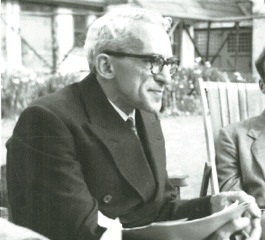
Alex Bloom was headteacher at St George’s-in-the-East school (Stepney, London) for 10 years in the immediate aftermath of World War II. In that time, he created a beacon of progressive education in the state sector, insisting that “a child can’t grow up in an atmosphere of fear.” As the Daily Mirror reported in 1951, the school did not have “formal lessons in the accepted sense, tests or competitions, prizes for achievement, penalties for failure, imposed punishment, division of children into ‘bright’ or ‘dull’ classes.” Continue reading “Alex Bloom’s progressive school community”
Category: State schools
#leftytrad – a contradiction in terms?
I’ve recently come across Adam Boxer’s blog post on being a ‘lefty’ in politics and a ‘trad’ in teaching. He complains that there is a “consistent and widespread conflation of traditional education with right wing politics” – a conflation that is not warranted. Indeed, Boxer stresses that he is a traditional teacher precisely because he is left-wing:
I believe that everyone, regardless of their background, should be able to access society at any level. I believe that a highly effective way to achieve that is by transmitting the cultural goods of society; its finest discourse and mores. I also believe that our cultural and intellectual goods are the right of all citizens, whatever their backgrounds.
Boxer goes on to claim that politics and teaching methods are not related. His left-wing views, he argues, have not changed since employing progressive approaches as a lefty NQT. However, he has come to the realisation that the best way to educate for social equality – i.e. “level the field and to pass on society’s goods” – is to teach as a traditionalist. The assertion that traditional teaching methods and left-wing views are compatible deserves scrutiny.
Boxer’s use of progressive and then traditional methods reminds me of the most advanced left-wing government in history. The Russian Revolution unleashed a period of unparalleled experimentation and creativity, promoting progressive education in an attempt to raise the cultural level of the population. It was a time of hope in the capacity of humans to improve themselves and build a better society. The aim of education was to inculcate a sense of agency in students so they could play an active role in the new developments. That all changed with the rise of Stalin. He viewed education as a means of achieving popular compliance for his brutal five-year plans. To achieve that compliance he returned schools to the traditional methods of the repressive Tsarist regime.
Both the revolutionaries of the new Soviet state and the bureaucrats of Stalin’s regime would have considered themselves left-wing. However, they had different aims for education. The progressives wanted to harness the creative agency of the population to participate in building a new society; the traditionalists wanted to force the population to submit to hardship and misery. The label ‘left-wing’ is, therefore, misleading. It is the aim of education that is at the heart of the debate between progressives and traditionalists.
Let’s turn then to Boxer’s aim. Maybe it is acceptable for traditional teaching to reinforce messages of compliance, teacher authority and student passivity if ‘disadvantaged’ students from ‘poorer’ backgrounds gain, as Boxer puts it, access to society at any level.
To achieve that access, Boxer argues that teachers have to transmit the finest cultural goods of society. The problem with this formulation is that it requires the ‘disadvantaged’ to deny their own culture because, as Marx and Engels said in The German Ideology, ‘finest’ is defined by the rulers of society:
The ideas of the ruling class are in every epoch the ruling ideas, i.e. the class which is the ruling material force of society, is at the same time its ruling intellectual force.
In calling for the assimilation of all children into the dominant culture, Boxer is, in reality, advocating the abandonment of any alternative culture. Working class children must disregard their forebears’ history of struggle; migrants must disavow their parents’ cultural heritage. This makes Boxer’s prescription wholly undemocratic.
Not only can we say that traditionalist teaching methods force students to comply, but we can also say that traditionalists aim for compliance with the dominant culture of the rich and powerful. In my view, the traditionalists’ approach and aim are the antithesis of what the left should stand for.
Progressive educators engage with students’ experiences and cultures as well as teaching students about the “intellectual goods” of the dominant culture. Such an approach is left-wing because it aims for a society in which the ‘disadvantaged’ have agency and in which all cultures are acknowledged and valued.
Ofsted: attack dog and lapdog
I am not unbiased in the discussion about Ofsted. Over the last five years, I have worked in two schools that have been downgraded from ‘good’ to ‘requires improvement’ within weeks of starting there. Unlucky? Yes, but the experience has given me a detailed view of the injustices of our education system. I have witnessed the paranoia and stress that follows an RI rating.
The first school has spiralled out of control. The leadership was dismantled: the head teacher was paid off and left suddenly; the deputy head, disillusioned by the arbitrary nature of the inspection process, moved out of the state sector . (The inspection started well, but became hostile when the inspectors were themselves inspected on the second day.) All national measures of the school have fallen sharply and, as one previous colleague says, the new leadership has introduced “a pervasive culture of deceit.” She recounts that superficial initiatives are relentlessly rolled out on a weekly basis. Many are counter-productive or even damaging and none are given the time to have any impact. She is leaving teaching.
At the second school, the inspection team was extremely negative from the start. Evidence of classroom practice was ignored. The data, which seemed to put the school inside ‘good’, was twisted to fit a pre-determined narrative. A quarter of the staff left the school at the end of the year. The school leaders now throw huge resources at students facing national exams, put extra pressure on staff and increase our workload. We don’t criticise because we know they are fighting for their careers.
The common feature of the schools is the socio-economic deprivation of the areas they serve. The percentages of ‘disadvantaged’ students in both are amongst the highest in the country.
In arguing that “Ofsted currently does more harm than good,” Professor Coffield cites evidence that the “most deprived schools are systematically more likely to be downgraded than the least disadvantaged” and concludes that they are “harmed by inaccurate and biased Ofsted reports.” The Education Policy Institute report that the professor quotes also states that “schools with more disadvantaged pupils are less likely to be judged ‘good’ or ‘outstanding’, while schools with low disadvantage and high prior attainment are much more likely to be rated highly.” Why should this be?

Neither the professor nor the report addresses the question. The government’s academy programme has stalled, not least in parliament where the Conservative’s reduced majority has forced ministers to withdraw their most reactionary policies. Now, the only route to increase the number of academies by force is through an Ofsted rating of ‘inadequate’ or ‘requires improvement’. The former leads to immediate academisation; the latter gives the school an initial two years to improve and then another two if required. In this way, Ofsted acts as the attack dog of their political masters, promoting their academy programme when it cannot be pursued through democratic means.

Similarly, neither the professor nor the report raises the political motives behind why schools in deprived areas are more likely to face biased inspections and be downgraded to RI. This can only be explained by the position of the majority of such schools in inner-city Labour areas. Downgrading a school in the Shires could bring out the middle classes and that would reflect badly on the local Tory council. In this way, Ofsted acts as the lapdog of their political masters, trying to avoid upsetting the government’s political friends.
Meanwhile, the politicians demand that Ofsted goes further and prove its cringing subservience in other ways. Ofsted now falls over itself to promote its masters’ traditionalist teaching methods. These, of course, are as damaging as the rest of the government’s education programme. The school’s minister cherry picks research to support his traditionalist agenda and then forces Ofsted to promote stultifying direct instruction. Just as the bully always demands more, the schools minister continues to berate Ofsted even when it has demonstrated its spineless loyalty many times over.
That Ofsted is simultaneously the government’s attack dog and lapdog leaves the progressive teacher in a quandary. Does she abandon teaching for the quieter and more gentile life of the consultant or teacher trainer? Does she abandon the state system and go to an enlightened international school abroad? Or does she stay and fight for her ideals about teaching ‘disadvantaged’ students in the knowledge that bullies never win in the end?
Is progressive education dead in state schools?
To answer the question, we need to define what we mean by progressive education. Steve Nelson writes in First Do No Harm that, “A fundamental concept of progressive education is the idea of children being agents or architects of their own learning.” For me, this is the fundamental concept. Children negotiate with the teacher over what, when and how to study, learning to take and justify decisions independently.
Using this definition, it is obvious that progressive education in the state sector has largely been extinguished. National Curricula dictate what to teach and when to teach it; official decrees prescribe how to teach. In England, the 1988 Education Act set the curriculum and the National Strategies sought to impose the teaching model (a role since taken on by the current Schools Minister). Not only is the state sector devoid of student agency, there is also very little space for teacher agency. These developments have been compounded by the accountability measures on schools, which have become more draconian, and the budget cuts that see class sizes increase. It is very difficult to promote self-directed learning in my year 9 ‘bottom’ set, which now contains 30 students, while covering a packed compulsory curriculum.
As progressive education has been wiped out in state schools, progressive teachers have found it difficult to stay in the classroom. Those that leave and wish to continue in education have taken one of two paths. Either they have moved into academic careers where they become increasingly out of touch, marginalised and irrelevant. Or they become consultants. Those in this category are generally middle-class liberals who disown their progressive roots for fear of offending prospective employers. They deny there is a dichotomy between progressive and traditional models and claim there is ‘no right way’ to teach. They adopt ‘reasonable’ and ‘balanced’ positions in a self-serving attempt to remain marketable to as many headteachers as possible.
These people survive selling their expertise because, while progressive education has all but disappeared in state schools, it remains widespread in the independent sector. Two
of the most expensive schools in New York, for example, are progressive: the Dalton School (annual fees: $46 000) and Calhoun (annual fees: $38 000). Even President Obama (who, with heavy irony, named his education act Every Student Succeeds) sent his daughters to the progressive University of Chicago Laboratory School (annual fees: $34 000) set up by John Dewey. At a more modest level, international schools using the IB’s inquiry-based programmes attract business from local elites and foreigners working for multi-nationals. It is always amusing to hear traditionalists calling for ‘disadvantaged’ children to be taught like their peers from wealthy families who attend independent schools. Of course, they never add that a good proportion of those independent schools use progressive methods.
Notwithstanding the bleak picture in the state sector, some progressives do stay and attempt to subvert the reactionary system. These individuals endeavour to develop students as agents and architects of learning within the constraints they face. They take inspiration from the very few contemporary progressive state schools serving areas of high deprivation, such the Science Leadership Academy in Philadelphia. Steadfast in their belief that all children deserve the opportunity to experience the progressive education that, at the moment, is only available to the children of the wealthy, these teachers are laying the foundations for a better and brighter future.